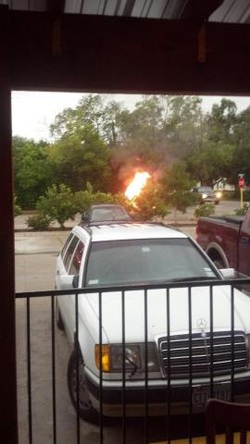
Imagine that you have just been in a wreck.  You expect that the other driver will come over to your car and check on you, so you can exchange information.  Instead, the other car drives away.

For a fleeting moment, you get a look at the license plate, but it's just gibberish and you cannot recognize and remember it.

That scenario plays itself out daily.

Part of the problem is that states are making license plates that are hard to read.  Colorful backgrounds, eye-catching logos, state slogans, and an inconsistent numbering scheme all combine to make license plate numbers hard to see and remember when you only get a moment.

Here is what a good license plate used to look like:
Picture
This is clean. Three letters and three numbers.  TNF 990.  Even if you only get a moment as the vehicle flees, you can remember TNF 990.

Then the state started moving the letters and the numbers around.  Sometimes the letters and numbers were mixed in the same grouping.

Picture
Do we really need the space shuttle, cowboy and the slogan to clutter up this license plate?

Now, let's really mess it up.  This is the current license plate with scrambled letters and numbers, as well as background color.

Picture
Very pretty, but very hard to read and memorize. 

So, of the three license plates, which is the best for its intended purpose?  Which is the best for allowing you or a police officer to quickly identify a vehicle? 

For Texas License Plate history and images, take a look at http://www.15q.net/tx.html


Texas Gov. Rick Perry vetoed the Legislature’s plan to ban text messaging for all drivers.

Perry called the distracted driving legislation a “government effort to micromanage the behavior of adults.” The veto came June 17. The law would have taken effect Sept. 1, 2011.

“The keys to dissuading drivers of all ages from texting while driving are information and education,” Perry said in his veto statement. He is campaigning for president, wooing voters on the right.

About a dozen bills addressing texting and driving were considered during the 2011 session.

Two new Texas distracted driving laws are in effect:

One banning teen drivers from using cell phones and text messaging devices;

the other prohibiting drivers from using handheld cell phones in school crossing zones.

Current prohibitions:

* Drivers under the age of 18 are prohibited from using wireless communications devices.

* Learners permit holders are prohibited from using handheld cell phones in the first six months of driving.

* School bus operators prohibited from using cell phones while driving if children are present.

* Drivers prohibited from using handheld devices in school crossing zones.

* Dallas, San Antonio, Austin, Amarillo, Galveston, El Paso, Missouri City and Stephenville are among the Texas cities that have enacted local distracted driving laws.

Read the Texas statutes.

Text messaging and cell phone use while driving are bigger problems than five years ago, Texas motorists say. 85 of drivers interviewed said text messaging was worse, while 80 percent agreed that cell phone use had become a bigger problem than a half decade ago. (The Texas Transportation Institute interviewed 1,167 motorists at Texas Department of Public Safety Driver License Offices in fall 2010.) Supporters of a ban on handheld cell phone use while driving outnumber opponents by a two-to-one margin. Aggressive driving ranked with distracted driving as a danger cited by the drivers. (View a video about the Texas driver safety survey.)

Missouri City’s ban on texting while driving went into effect June 1, 2010. Law applies when vehicle is stopped. Fines up to $500. The city posted traffic signs stating: “No Texts Emails or Apps While Driving.”

Galveston has banned text messaging while driving within city limits. Fines up to $500. The City Council voted to outlaw texting for motorists on Jan. 14 and the ban went into effect immediately.

Source credit: http://handsfreeinfo.com/texas-cell-phone-laws-legislation


A new study shows that texting while driving basically doubles a driver’s reaction time and makes the driver less able to respond to sudden roadway dangers, but do people really realize the danger?

Bumper sticker evidence, or this case a window sticker on the back of an SUV in Sugar Land, Texas, suggests that we are getting the message.
 
 
After determining that it's not safe to get behind the wheel after taking even a single drink of alcohol, researchers at the University of California, San Diego want the nation’s states to lower their legal blood alcohol content (BAC) limits.

In all states, a blood alcohol content level at or above 0.08 percent is the legal limit for operating a motor vehicle, reports the Insurance Institute for Highway Safety. Researchers at the university found that even lower levels may put drivers and their passengers at risk, however.

A little goes a long way

Led by sociologist David Phillips, researchers at the university analyzed data from the Fatality Analysis Reporting System (FARS), which includes information on all people in the U.S. who were involved in fatal car accidents. They looked at nearly 1.5 million people involved in fatal accidents from 1994 to 2008.

Drivers who believe they can drive with an alcohol “buzz” without putting themselves at risk are very much mistaken, says Phillips.

"We found that injuries from automobile accidents were more severe when drivers had any blood alcohol content, even as low as 0.01," Phillips says. "The rate of serious injuries among buzzed drivers was clearly higher than for sober drivers."

Phillips says the problem could stem from buzzed drivers being more likely to speed and less likely to wear seat belts. They also are more likely to crash into other cars, causing serious injuries. "When you have any alcohol in your system, not only do you drive poorly, but also your ability to make sound judgments worsens," he says.

Alcohol impairment can lead to crashes, lawsuits, jail time – and higher car insurance rates.

Researchers want states to reduce BAC limits

Phillips believes the evidence from the study is strong enough for every state to consider lowering its legal BAC. Until recently, some states had set their BACs at 0.10. As of this year, the legal limit was 0.08 in all 50 states, though some states such as Colorado can impose penalties with a BAC of .05 percent.

Phillips wants the U.S. to join countries such as Czech Republic, Brazil and Hungary, where it is illegal to drive with any alcohol in your system. If that's not realistic, he says the states could lower their blood-alcohol limits to 0.02 or 0.03 percent. Some other countries have adopted BACs of 0.02 percent, while others allow up to 0.05 percent.

"We hope our study, which provides empirical evidence for lowering the legal BAC even more, might influence U.S. legislators," Phillips says.

Concerns from MADD

Jan Withers, recently named president of Mothers Against Drunk Drivers (MADD), says she is not surprised by the study’s results. "We've always known that your judgment goes out the window the more you have to drink, and that when you get behind the wheel of a car drunk or buzzed you're putting not only yourself but others on the road at risk."

MADD wants people to choose a designated driver who will stay sober while the rest their party drinks. "That's our message over and over again, because it's so important," she says.

Despite the findings of the University of California, San Diego, Withers, whose daughter Alisa Joy was killed in 1992 by a drunk driver, doesn't believe states should lower their legal BACs any further.

"With every drink our sobriety levels go down," she says, "but at MADD we support the 0.08 blood alcohol content because that's the level the science and research shows is effective. MADD doesn't have an interest in pursuing anything lower than that."

Determining your BAC

Your blood alcohol level reflects how much alcohol is present in your blood as you drink. How much you can drink and still have a blood alcohol level below 0.08 depends on your gender, weight, the strength of your drinks and how much you eat while drinking.  A 120-pound woman typically would exceed the legal limit by consuming two drinks within one hour. A 180-pound man would hit the limit by consuming four drinks during the same period.

Source:  Beth Orenstein, written for www.insure.com
 
 
Drunken driving incidents have fallen 30 percent in the last five years, and last year were at their lowest mark in nearly two decades, according to a new federal report.

The decline may be due to the down economy: Other research suggests people are still drinking as heavily as in years past, so some may just be finding cheaper ways of imbibing than by going to bars, night clubs and restaurants.

"One possibility is that people are drinking at home more and driving less after drinking," said Dr. Thomas Frieden, director of the Centers for Disease Control and Prevention.

The CDC statistics — released Tuesday — are based on a 2010 national telephone survey of about 210,000 U.S. adults. The respondents were kept anonymous.

Nearly 1 in 50 said they'd driven drunk at least once in the previous month. That equates to about 4 million Americans driving drunk last year.

About 60 percent said they drove drunk just once, but some said they did it daily.

That led to a CDC estimate of more than 112 million episodes of drunken driving in 2010. That's more than 300,000 incidents a day.

CDC officials lamented that finding; still, it was the lowest estimate since the survey question was first asked in 1993, and down significantly from the 161 million incidents in the peak year of 2006.

Young men ages 21 to 34 were the biggest problem, accounting for just 11 percent of the U.S. population but 32 percent of the drunken driving incidents.

The overwhelming majority of drunken driving incidents involve people who had at least four or five drinks in a short period of time. But binge drinking has not been on the decline, other health research suggests.

The National Highway Traffic Safety Administration has also noted signs of an apparent recent decline in drunken driving. According to that agency's latest data, the number of people killed in U.S. crashes involving alcohol-impaired drivers dropped from 11,711 in 2008 to 10,839 in 2009.

"While the nation has made great strides in reducing drunk driving over the years, it continues to be one of the leading causes of death and injury on America's roads — claiming a life every 48 minutes," added David Strickland, the agency's administrator, in a prepared statement.

Source:  http://www.cdc.gov/vitalsigns
 
 
According to a new study released by the Texas Transportation Institute, texting while driving basically doubles a driver’s reaction time and makes the driver less able to respond to sudden roadway dangers, if a vehicle were to make a sudden stop in front of them or if a child was to run across the road. 

This is the first published study in the U.S. using actual drivers, rather than simulators. Studies have been confined to simulators in the past for safety concerns.

Researchers studied 42 drivers between the ages of 16 and 54 on a test-track driving course in vehicles equipped with a flashing light and a monitoring system. To put the findings in context, drivers going 60 mph travel farther than the length of a football field in four seconds. (60 mph = 88 feet per second)

If you’re on a freeway where the speed limit is 60 mph in rush hour and a vehicle suddenly stops in front of you, that is not enough time to react if your eyes are glanced down at your phone.

Drivers in the study were more than 11 times more likely to miss the flashing light altogether when they were texting.  The study also found texting impaired the ability of drivers to maintain proper lane position and a constant speed.

Texting and driving has already been deemed dangerous, with 34 states adopting texting and driving bans. The Texas Legislature approved a texting ban in 2011, but Gov. Rick Perry vetoed the measure, calling it an “overreach” and a “government effort to micromanage the behavior of adults.” Texas law does ban cellphone use in school zones and includes restrictions for drivers under the age of 18.

In 2009, nearly 5,500 people died and half a million were injured in crashes involving a distracted driver, according to figures from the National Highway Traffic Safety Administration. Distraction-related fatalities represented 16 percent of overall traffic fatalities in 2009, the agency said. It is unclear how many of those fatalities can be blamed specifically on texting.

Source credit:  www.washingtonpost.com